


Website Designs With A Luxury Color Palette
March 30, 2026
Top 10 Themes for Highly Interactive Websites in WordPress in 2026
March 31, 2026That small line of text at the bottom of your site is doing your brand no favors.
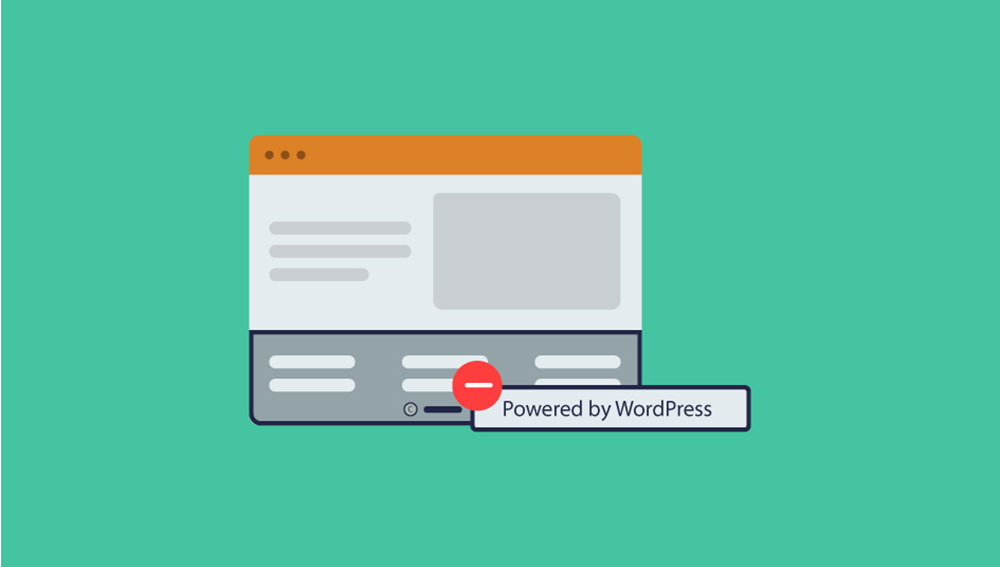
Knowing how to remove the "Proudly powered by WordPress" message is one of the first things any serious site owner should handle. It is a default footer credit link added by your active theme, pointing straight to WordPress.org.
Removing it is legal, takes under five minutes, and leaves zero impact on your search rankings.
This guide covers every method, from editing footer.php inside a child theme to using the WordPress Site Editor for block themes, page builders like Elementor Pro and Divi, and WooCommerce's Storefront theme.
You will also learn how to verify the footer removal is complete, including in the HTML source.
What Is the "Proudly Powered by WordPress" Message?
The "Proudly powered by WordPress" message is a footer credit link generated by the active theme, not by WordPress core directly. It points to WordPress.org and appears by default on most themes that follow standard WordPress template hierarchy conventions.
The credit lives inside the theme's footer.php file, typically rendered through the wp_footer() hook. Some themes output it as a hardcoded HTML string. Others use a PHP function hooked into a theme-specific action.
WordPress powers 43.4% of all websites globally as of 2025, according to W3Techs. That scale means this footer text shows up on tens of millions of live sites, many of which belong to businesses that would rather display their own brand.
Removing it is fully legal. WordPress is released under the GNU General Public License (GPL), which gives you the right to use, modify, and redistribute the software freely. You are not legally obligated to display the attribution link, and removing it does not void your license (XsOne Consultants, 2026).
The message is a followed outbound link on every page of the site. It creates no legal issue to remove, and no WordPress functionality depends on its presence.
Where Does the Footer Credit Come From?
Source location: The credit text lives in /wp-content/themes/your-theme/footer.php, not in WordPress core files.
- Classic themes output it via a PHP function inside
footer.php - Block themes add it as a Paragraph block inside a Footer template part
- Some theme frameworks (like Genesis) use a dedicated filter hook instead
- WooCommerce's Storefront theme uses a separate
storefront_creditfunction hooked tostorefront_footer
The method you use to remove it depends entirely on which of these applies to your setup.
Why Do Some Themes Make It Hard to Remove?
Not all themes put the credit in footer.php. Some encode it inside a core.php or functions.php file and hook it through a custom action.
Themes like Verbosa, for example, route the footer output through a custom hook like cryout_master_footer_hook, which means creating a child theme and overriding footer.php will not work. You have to locate and comment out the specific function call directly in the parent theme file, which gets overwritten on updates.
If your theme makes removal this tricky, that is a design decision by the theme developer. Consider switching to a theme that follows standard WordPress template hierarchy conventions.
Does Removing the Message Affect SEO?
Removing the WordPress footer credit does not cause any measurable ranking change. No documented case study or Google guidance connects the presence or absence of this link to search performance.
The link is a followed outbound link to WordPress.org on every page of your site. Removing it reduces your total outbound link count per page, which is a minor cleanup, not a meaningful SEO lever.
| Factor | Impact of Keeping Link | Impact of Removing Link |
|---|---|---|
| Search rankings | No documented benefit | No documented loss |
| Outbound link count | Adds 1 followed link per page | Removes 1 followed link per page |
| HTML source visibility | Link crawlable by bots | Link absent from DOM |
| Branding signal | Exposes CMS choice | Clean custom brand footer |
One thing worth noting: hiding the credit with CSS display: none does not remove the link from the HTML source. The outbound link remains crawlable by search engines even if the user cannot see it visually. This is not a complete solution from an SEO perspective (Hostinger, 2025).
What Are the Actual Reasons to Remove It?
The decision is 3 parts branding, 1 part security. Here is what actually motivates most site owners:
- Brand consistency: A footer that reads "Copyright 2025 Your Business" looks more professional than a default CMS credit
- Security through obscurity: Hiding the CMS fingerprint deters automated scripts scanning for WordPress-specific vulnerabilities
- Design cleanliness: The default link often clashes with custom color schemes and footer typography
- Client deliverables: Agencies building sites for clients typically remove all third-party credits before handoff
How Do You Remove the Message by Editing footer.php Directly?
Editing footer.php directly is the fastest path for classic themes. Do this only inside a child theme, never in the parent theme file itself.
Direct edits to a parent theme's footer.php are overwritten every time the theme updates. A child theme's footer.php takes priority over the parent's version in the WordPress template hierarchy, and survives updates.
Why a Child Theme Is Required for This Edit to Persist
WordPress resolves template files by checking the child theme directory first, then the parent theme directory. A footer.php file placed in your child theme folder overrides the parent's version completely.
Without a child theme, your edit disappears the next time you click "Update" on your theme. Most theme developers release updates every few months. You would lose the change repeatedly.
To create a basic child theme: Create a new folder in /wp-content/themes/, add a style.css with the correct theme header, and enqueue the parent stylesheet in functions.php. WordPress.org documentation covers the exact format.
How to Locate the Credit Line in footer.php
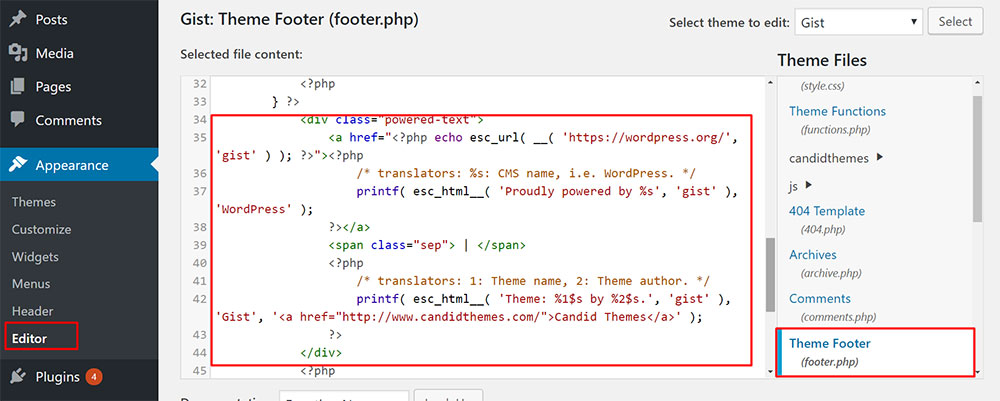
Open the footer.php file from your child theme directory via FTP/SFTP or through Appearance > Theme File Editor.
Search for these strings to find the credit output:
proudlywordpress.orgPowered bysite-info(used in some default themes like Twenty Twenty-Two)
Delete the line or PHP block that outputs the credit text. Save the file. Clear your caching plugin before checking the result.
How Do You Remove the Message Using a Child Theme?
The child theme method is the correct, update-safe approach for any classic theme that stores the footer credit inside footer.php. It covers the majority of traditional WordPress themes.
The process has 4 steps:
- Create a child theme if one does not exist
- Copy
footer.phpfrom the parent theme directory into the child theme directory - Edit the copied file to remove the credit line
- Activate the child theme in Appearance > Themes
Once active, WordPress will use the child theme's footer.php and ignore the parent's version. When the parent theme updates, your modified copy in the child theme stays untouched.
What If the Credit Is in a Different File?
Some themes do not put the credit directly in footer.php. They call a separate template part file like template-parts/footer/site-info.php.
If your credit survives after you edit footer.php, search the theme's folder structure for files containing the word "proudly" or "wordpress.org". Copy that specific file into your child theme directory, maintaining the same folder path, then edit it there.
The WordPress template hierarchy rule applies to partial template files as well. A matching file path in the child theme takes priority.
How Do You Remove the Message Without Touching Theme Files?
Two no-code approaches work here: a plugin or a functions.php hook. They differ in dependency weight and control.
| Method | How It Works | Best For | Downside |
|---|---|---|---|
| Plugin (Remove Footer Credit) | Intercepts footer output via hook | Non-technical users | Adds plugin dependency |
| functions.php hook | Uses remove_action() to suppress output |
Developers, lean setups | Requires finding correct hook name |
| CSS display: none | Hides text visually | Quick visual fix only | Link stays in HTML source, crawlable |
Using functions.php to Remove the Footer Output
This approach works when the theme outputs the credit via an action hook rather than hardcoding it in footer.php. Add the following to your child theme's functions.php:
add_filter( 'get_the_generator_xhtml', '__return_false' );For the Storefront theme specifically, the credit function is called storefront_credit and is hooked to storefront_footer with a priority of 20. Remove it with:
function remove_storefront_credit() {
remove_action( 'storefront_footer', 'storefront_credit', 20 );
}
add_action( 'wp_head', 'remove_storefront_credit' );
Other theme frameworks use different filter names. Genesis uses genesis_footer_creds_text. If your theme has its own action hook for footer output, check the theme's documentation or search the theme files for add_action calls near the footer credit function.
Why CSS Hiding Is Not a Complete Solution
Applying display: none to the footer credit removes it visually. The HTML element, including the outbound link to WordPress.org, remains present in the page source.
Search engine crawlers read the HTML source directly. They will still follow and index the link even if no visitor ever sees it. Hostinger's documentation flags this explicitly as a method that can affect the site's SEO, not improve it (Hostinger, 2025).
Use CSS hiding only as a temporary measure while implementing a proper code-based solution.
How Do You Remove the Message in Block Themes (Full Site Editing)?
Block themes do not use footer.php. The footer is a template part edited inside the WordPress Site Editor. 60% of new WordPress themes now use Full Site Editing, and that figure grew 145% in 2025 alone (Colorlib, 2026).
The removal process requires no code at all:
- Go to Appearance > Editor in the WordPress dashboard
- Open Template Parts > Footer
- Click the Paragraph block containing "Proudly powered by WordPress"
- Delete the block entirely or replace it with your own text
- Click Save
This applies to Twenty Twenty-Three, Twenty Twenty-Four, Twenty Twenty-Five, and any theme built with Full Site Editing support. Changes save directly to the theme's template parts and persist through theme updates, which is a key advantage over the child theme approach for classic themes.
How the Site Editor Handles Footer Template Parts
In block themes, the footer is not a PHP file. It is a block template part stored in the theme's /parts/footer.html file, expressed as block markup.
When you edit it in the Site Editor, WordPress saves your modifications to the database as a custom template part override. The original theme file stays untouched. This means your edits survive even if the theme author updates their default footer template.
If you need to revert to the original footer, go to Appearance > Editor > Template Parts > Footer and click "Reset to default." WordPress will discard your saved override and restore the theme's original version.
How Do You Remove the Message in Page Builders Like Elementor or Divi?
Elementor Pro and Divi both override the standard theme footer rendering. Editing footer.php or the Site Editor will have no effect when one of these builders controls the footer output.
A 2025 WP Engine poll found that 68% of WordPress professionals now prefer native FSE themes over page builder solutions. But Elementor still holds 43% of active page builder usage as of May 2026 (WPZOOM, 2026), so this method covers a significant share of live sites.
Removing the Credit in Elementor Pro
Path: Templates > Theme Builder > Footer
Open your active footer template in the Elementor editor. Locate the text widget or HTML widget that contains the "Powered by WordPress" text. Select it and delete it, or replace the text with your own copyright line. Click Publish when done.
If no footer template exists in the Theme Builder, it means Elementor is not controlling the footer and you should use one of the theme file methods instead.
Removing the Credit in Divi
Path: Divi > Theme Customizer > Footer > Bottom Bar
Divi provides a dedicated toggle: check the "Disable footer credits" checkbox and click Save and Publish. This removes both the "Designed by Elegant Themes" and "Powered by WordPress" credits in a single step (QuadLayers, 2025).
Alternatively, use Divi's Theme Builder at Divi > Theme Builder, open the Global Footer template, and edit the module containing the credit text directly.
How Do You Remove the Message in WooCommerce Sites?
WooCommerce powers over 4.5 million active online stores globally as of 2025, according to StoreLeads. Most of those stores run on the Storefront theme, which adds its own footer credit on top of the default WordPress one.
The 2 credits are separate. They come from different functions and require different removal steps.
| Credit Text | Source Function | How to Remove |
|---|---|---|
| "Proudly powered by WordPress" | Theme's footer.php or block template part |
Child theme override or Site Editor |
| "Built with Storefront & WooCommerce" | storefront_credit function |
storefront_credit_link filter or remove_action() |
WooCommerce does not add its own footer credit. The Storefront theme does. If you are not using Storefront, only the standard WordPress footer credit removal applies.
How to Remove the Storefront Credit with a Filter
Fastest method: one line in your child theme's functions.php.
add_filter( 'storefront_credit_link', '__return_false' );This uses the storefront_credit_link filter hook documented in WooCommerce's official Storefront hooks reference. It suppresses the credit link output without touching any theme files.
To remove the entire credit block including the copyright text, use:
add_filter( 'storefront_credit_links_output', '__return_empty_string' );Both snippets require a child theme. Direct edits to Storefront's functions.php are overwritten on updates (BusinessBloomer, 2020).
What If Storefront and WordPress Credits Both Appear?
Both credits showing means neither filter has fired yet. Apply both removal methods independently.
- Use the
storefront_credit_linkfilter for the Storefront credit - Use a child theme
footer.phpoverride for the WordPress credit - Confirm both are added to the child theme's
functions.php, not the parent theme
After saving, clear your caching plugin and reload the page in an incognito window. If both credits are gone, you are done. If one remains, check the functions.php hook spelling exactly against the Storefront hooks documentation.
What Breaks When You Remove the Message?
Nothing in WordPress core depends on the footer credit link being present. Removing it causes zero functional impact on any WordPress feature, plugin, or theme behavior.
But 3 specific issues can appear after removal, depending on the method used.
Parent Theme Updates Overwrite Direct Edits
Only applies to: direct edits made to the parent theme's footer.php without a child theme.
Theme updates replace all parent theme files. Your credit removal disappears the next time you click Update.
The fix is the same every time: create a child theme, copy footer.php into it, and make your edits there. WordPress reads the child theme version first, so updates to the parent no longer affect your footer.
CSS Hiding Leaves the Link in the HTML Source
A display: none rule removes the credit visually. The outbound link to WordPress.org stays in the page source, crawlable by search engine bots on every page of the site.
Screaming Frog SEO Spider can confirm this. Run a crawl after applying your removal method, then filter the Outlinks tab by "wordpress.org" to check whether any pages still output the link. The free version crawls up to 500 URLs, which covers most small sites.
Some Themes Output Credits from Multiple Files
Themes with custom template parts sometimes output the credit from a file other than footer.php, such as template-parts/footer/site-info.php.
Editing footer.php in those cases removes nothing. Use a file search via FTP or the Theme File Editor to find all instances of "proudly" or "wordpress.org" across the full theme folder before deciding which file to override.
How Do You Confirm the Message Has Been Fully Removed?
Visual inspection is not enough. The credit may still exist in the HTML source even if you cannot see it on the page.
Run these 3 checks after any removal method.
Check the Page Source Directly
MobiLoud data from 2024 shows 58% of web traffic comes from mobile devices. Check removal on both desktop and mobile views.
On desktop, press Ctrl+U (Windows) or Cmd+Option+U (Mac) to open the raw HTML source. Search for "proudly" using Ctrl+F. If the string does not appear, the link is gone from the source.
Also check the rendered DOM in browser DevTools under the Elements tab, since some themes inject content via JavaScript after page load.
Clear All Caches Before Testing
Test order matters:
- Clear your WordPress caching plugin first (WP Super Cache, W3 Total Cache, LiteSpeed Cache, or WP Rocket)
- Clear your browser cache or test in an incognito window
- If using a CDN like Cloudflare, purge the CDN cache as well
- Then reload the page and check the source
Skipping cache clearing is the most common reason people think the removal did not work. The cached HTML still contains the old credit text.
Use a Crawler to Verify Across the Full Site
For multi-page sites: a single page check is not enough.
Screaming Frog SEO Spider crawls the full site and logs all outbound links. After crawling, open the Outlinks tab and filter by the target URL "wordpress.org" to identify any pages still outputting the footer link.
Some themes apply different footer templates to specific page types (archives, 404 pages, custom post types). A full-site crawl catches these edge cases that a manual check misses.
Also run a quick check on the mobile view of your site. Some themes, including those built with Elementor Pro, allow separate mobile and desktop footer sections. If only the desktop footer was edited, the mobile footer may still show the credit (Elementor, 2025).
FAQ on How To Remove The Proudly Powered By WordPress Message
Is it legal to remove the "Proudly powered by WordPress" footer credit?
Yes. WordPress is released under the GNU General Public License (GPL), which gives you full rights to modify and redistribute the software. You are not legally required to display the attribution link, and removing it does not violate the license in any way.
Will removing the footer credit hurt my SEO rankings?
No documented ranking change results from removing it. The link is a followed outbound link to WordPress.org on every page. Removing it is a minor cleanup with no measurable SEO impact, positive or negative.
Why does the footer credit come back after a theme update?
You edited the parent theme's footer.php directly. Theme updates overwrite that file. Always make edits inside a child theme. The WordPress template hierarchy loads the child theme's version first, so updates never touch it.
Does hiding the credit with CSS actually remove it?
No. display: none hides the text visually but leaves the outbound link in the HTML source. Search engine crawlers still read it. Use a code-based removal method through footer.php or a WordPress hook instead.
How do I remove it on a block theme like Twenty Twenty-Five?
Go to Appearance > Editor > Template Parts > Footer. Click the Paragraph block containing the credit text and delete it. Save. Block themes use the Site Editor, not footer.php, so no child theme or code is required.
How do I remove it in Divi?
Navigate to Divi > Theme Customizer > Footer > Bottom Bar. Check the "Disable footer credits" toggle and click Save and Publish. This removes both the Elegant Themes credit and the WordPress credit in one step.
How do I remove it in Elementor Pro?
Go to Templates > Theme Builder > Footer. Open your active footer template. Locate the text widget containing the footer credit link and delete it. Set the display condition to Entire Website, then publish the template.
Do I need to remove two separate credits on a WooCommerce Storefront site?
Yes. Storefront adds its own "Built with Storefront and WooCommerce" credit separately from the WordPress one. Add add_filter( 'storefront_credit_link', '__return_false' ); to your child theme's functions.php to remove the Storefront credit independently.
How do I confirm the footer credit is fully gone?
Clear your caching plugin, then press Ctrl+U to view the raw page source. Search for "proudly" in the source. If nothing appears, the footer credit removal is complete. Also run a Screaming Frog crawl to check all pages site-wide.
Can I use a plugin to remove the footer credit without touching any code?
Yes. Plugins like Remove Footer Credit handle this without file edits. Install, activate, and configure. The trade-off is an added plugin dependency on every page load. A functions.php hook is leaner if you are comfortable with basic PHP.
Conclusion
This conclusion is for an article presenting every practical method to remove the WordPress footer credit, from child theme file edits to block theme template parts and page builder overrides.
The right approach depends on your setup. Classic themes need a child theme footer.php override. Block themes use the Site Editor. Divi and Elementor Pro each have their own template controls.
WooCommerce Storefront sites need 2 separate removals: one for the WordPress credit, one for the storefront_credit_link filter.
Whatever method you use, always verify through the raw page source, not just the visual footer. Clear your cache first.
Clean footer. Clean brand. No outbound link to WordPress.org on every page of your site.