
Fixing the Failed to Load Resource Error in WordPress
June 12, 2026
The Best WordPress Themes for Designers To Use
June 15, 2026Your WordPress site just went blank. No warning, no explanation, just a white screen and a PHP warning you did not ask for.
The failed to open stream error is one of the most disruptive PHP fatal errors in WordPress. It stops page execution cold and can lock you out of wp-admin entirely.
This guide covers every confirmed cause and fix, from wrong file paths and missing plugin files to broken permissions, corrupted wp-config.php, and PHP version conflicts after a server upgrade.
By the end, you will know exactly how to diagnose the error, restore site access without the dashboard, and prevent it from recurring.
What Is the "Failed to Open Stream" Error in WordPress?
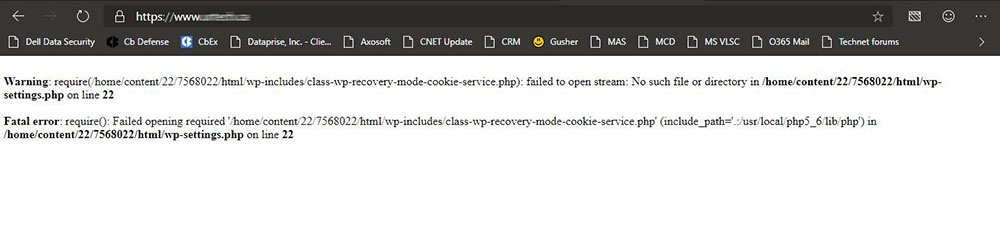
The "failed to open stream" error is a PHP stream wrapper failure. PHP tries to locate or access a file at a path specified in the code and cannot do it, so script execution stops.
The full error string looks like this:
Warning: require(): Failed to open stream: No such file or directory in /path/to/file.php on line X
Three root triggers cause every variation of this error: a wrong file path in the PHP call, a file that is physically missing from the server, or a file permission setting that blocks PHP from reading the file.
There is an important distinction between require() and include(). A require() or require_once() failure produces a PHP fatal error and halts the page entirely. An include() failure produces a warning but lets the page continue loading. In WordPress, most core files use require(), which is why this error typically produces a white screen or a "There has been a critical error on this website" message.
WordPress powers 41.9% of all websites globally (W3Techs, June 2026), which puts this error in front of an enormous number of site owners. The three most common sources inside WordPress are themes, plugins, and wp-config.php.
| Error Source | PHP Function Involved | Typical Symptom |
|---|---|---|
| Missing plugin file | require_once() | White screen or critical error |
| Wrong file path in theme | require() / include() | Broken frontend, error logged |
| Permission denied on file | fopen() / require() | 403-type stream failure, fatal error |
| Corrupted wp-config.php | require_once() | Entire site down, no admin access |
What Causes the Failed to Open Stream Error in WordPress?
Five confirmed root causes produce this error. Knowing which one applies before touching any file saves time and avoids making things worse.
File Path Errors
The most common cause. PHP cannot find the file because the path in the require() or include() call does not match the actual file location on the server.
This happens most often after a site migration, a server move, or when custom code uses a hardcoded absolute path instead of WordPress path constants like ABSPATH or WP_CONTENT_DIR.
Linux servers are case-sensitive. A file named MyPlugin.php will not be found if the code calls myplugin.php. Some FTP clients silently change letter casing during upload, which produces this exact mismatch.
Missing or Incomplete Files
The file PHP is trying to load simply does not exist on the server.
- Incomplete plugin or theme upload (connection dropped mid-transfer)
- A failed WordPress update that removed the file without replacing it
- Manual deletion of a file that another plugin or theme depends on
Patchstack's 2025 State of WordPress Security report found that 96% of the 7,966 WordPress vulnerabilities reported in 2024 came from plugins. Plugin file issues, whether from bad updates or incomplete uploads, are behind a large share of stream failures.
Permission Issues
Server file permissions: PHP's process does not have read access to the file. The error message in this case reads failed to open stream: Permission denied.
Common trigger: Files set to 000 or 400 after a server move, or directories set too restrictively after a malware cleanup.
Also common: Files set to 777 after a "quick fix" attempt. Some servers actively block execution of world-writable files as a security measure, which produces the same stream failure.
Corrupted Core Files
wp-config.php or wp-settings.php corruption causes a stream failure on every page load, since WordPress requires these files first. Corruption can come from a failed update, a partial file transfer, or malware that modified the file.
PHP Version Conflicts
A PHP upgrade removes or deprecates functions that older plugins use. get_magic_quotes_gpc() and each() were both removed in PHP 8.0. A plugin calling either function after the upgrade throws a fatal error that surfaces as a stream failure.
WordPress 6.6 raised the minimum supported PHP version to 7.2.24. Sites still running PHP 7.0 or 7.1 after a WordPress update will see stream errors from core files that now use functions unavailable in those versions.
How to Fix a Wrong File Path Causing the Error
Read the error message first. It tells you the exact file PHP tried to open and the file that called it. Both pieces of information are in the error string.
Example: require(/home/user/public_html/wp-content/plugins/myplugin/missing-file.php): failed to open stream
The path after require( is where PHP looked. Connect via FTP using FileZilla or via cPanel's File Manager and check whether that file exists at that exact path.
Replace Hardcoded Paths with WordPress Constants
Hardcoded absolute paths break every time the site moves to a new server or directory. WordPress provides constants that always resolve correctly.
- ABSPATH: root directory of the WordPress installation
- WP\CONTENT\DIR: full path to the wp-content folder
- plugin\dir\path(\\FILE\\): directory of the current plugin file
- \\DIR\\: PHP magic constant for the current file's directory
Replace any hardcoded path like /home/user/public_html/wp-content/ with WP_CONTENT_DIR . '/' and the path will resolve correctly after any server move.
Edit Files via SFTP, Not the Theme Editor
The built-in WordPress theme and plugin editors do not give you access to the full file structure. SFTP via FileZilla or WinSCP gives you direct server access with no file-size restrictions and a full directory view.
Always edit a local copy first, verify it works, then upload. Editing files directly on the server with no backup is how one typo takes down an entire site. I've seen developers spend hours debugging what turned out to be a missing closing bracket introduced during a live edit.
How to Fix Missing or Deleted Plugin and Theme Files
The error path in the PHP warning identifies which plugin or theme owns the missing file. Match the folder name in the path to the plugin or theme directory under /wp-content/plugins/ or /wp-content/themes/.
Fixing Missing Plugin Files
Download a fresh copy of the plugin from WordPress.org or the original vendor. Upload the entire plugin folder via FTP, overwriting the existing files. This replaces any missing or corrupted files without touching your database settings.
If the wp-admin is inaccessible because the error fires on every page, deactivate the plugin directly in the database. Open phpMyAdmin, select the wp_options table, find the row with option_name = active_plugins, and remove the offending plugin's entry from the serialized array.
WP-CLI is faster if you have SSH access: wp plugin deactivate plugin-slug deactivates the plugin in one command without touching the database manually.
Fixing Missing Theme Files
Switch to a default theme when a theme file is missing and the admin is inaccessible. In phpMyAdmin, go to the wp_options table and update both the template and stylesheet rows to twentytwentyfour.
After restoring admin access, re-upload the original theme from a clean download. Verify file integrity after upload by checking file sizes against the original. A file that uploaded at 0 bytes is a failed transfer, not a successful one.
Automattic's Twenty Twenty-Four theme ships with every WordPress installation and works as a reliable fallback during any theme recovery.
How to Fix File Permission Errors Triggering the Stream Failure
WordPress has a defined correct permission structure. Any deviation from it either causes stream failures or creates security vulnerabilities.
| File/Directory Type | Correct Permission | Why |
|---|---|---|
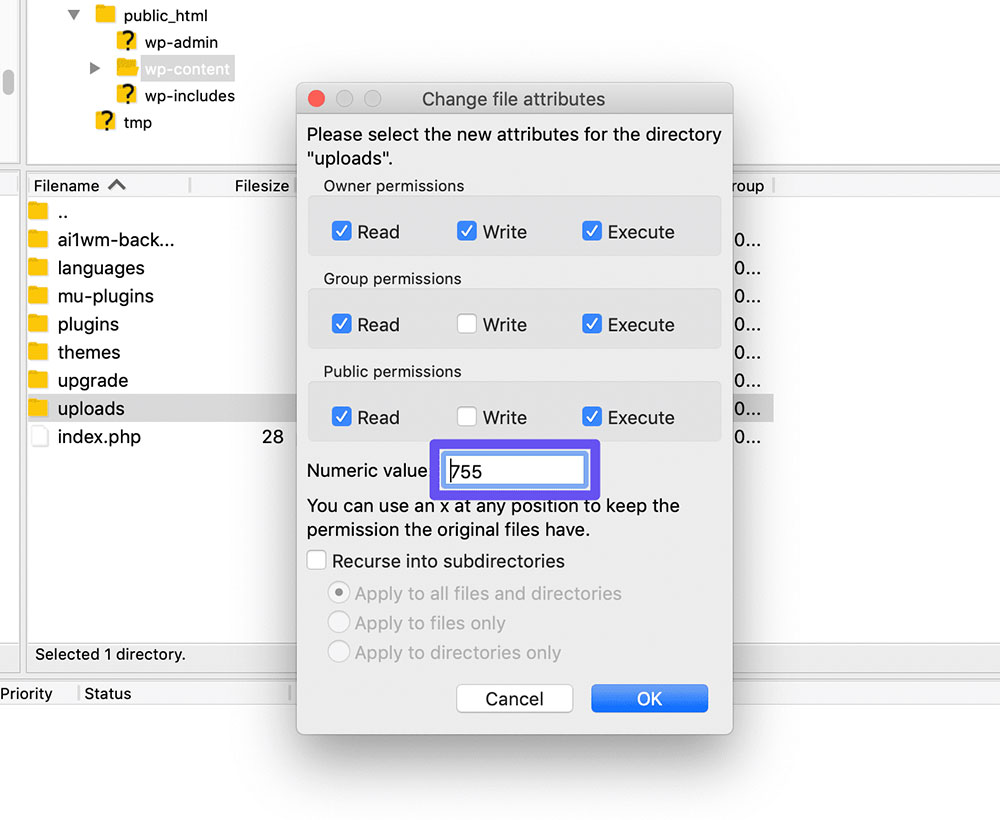
| WordPress directories | 755 | Owner can write; server can read and traverse |
| WordPress files (.php) | 644 | Owner can write; server can read only |
| wp-config.php | 600 or 640 | Contains DB credentials; restrict to owner only |
| wp-content/uploads | 755 | WordPress needs write access for media uploads |
How to Check and Change Permissions
Via FileZilla: Right-click any file or folder, select File Permissions, and enter the numeric value. Check "Recurse into subdirectories" and select "Apply to directories only" first for 755, then repeat with "Apply to files only" for 644.
Via SSH: Two commands reset all permissions across a WordPress installation.
find /path/to/wordpress -type d -exec chmod 755 {} \;
find /path/to/wordpress -type f -exec chmod 644 {} \;
Then set wp-config.php separately: chmod 600 wp-config.php
The 777 Problem
Setting files or folders to 777 is the most common "quick fix" that creates a worse problem. A permission of 777 grants read, write, and execute access to everyone, including anonymous visitors and other users on a shared server.
On some managed hosts like WP Engine, files set to 777 are actively blocked by the server's security layer. The result is the same stream failure you were trying to fix, plus a new security exposure.
If you find any 777 permissions during an audit, revert them immediately. The WP Engine support documentation lists failed to open stream: Permission denied as a direct symptom of incorrect file permissions requiring a reset.
Shared Hosting vs. VPS Behavior
On shared hosting, PHP typically runs as the same user as the file owner, so 644 permissions work without issue.
On a VPS using PHP-FPM or suPHP, the PHP process may run as a different user than the file owner. In that case, the web server needs group read access. Check your host's documentation for the specific ownership pattern their PHP handler requires before changing permissions.
How to Fix a Corrupted wp-config.php or wp-settings.php
A stream error originating from wp-settings.php or wp-config.php is distinct from a plugin or theme file error. The path in the error message will reference one of these two files directly.
Replacing wp-settings.php
Download the WordPress version that matches your installation from WordPress.org. Extract the zip. The clean wp-settings.php is in the root of the extracted folder.
Upload it via FTP to your site's root directory, overwriting the corrupted version. This file contains no site-specific configuration, so replacing it with a clean copy carries no risk of losing settings.
WP-CLI makes verification faster. Run wp core verify-checksums to check every core file against WordPress.org's official checksums. Any corrupted or modified core file appears in the output with its filename and the nature of the mismatch.
Handling wp-config.php Carefully
wp-config.php is different. It contains your database credentials, security keys, and site-specific constants. Never overwrite it entirely.
Instead: download the corrupted file, open it locally, and check for visible corruption like garbled characters, extra whitespace before the opening <?php tag, or duplicate entries. Extra whitespace before <?php is one of the most common causes of header-related stream failures and is easy to miss.
The 3 values in wp-config.php that must not be changed during any repair:
- DB_NAME - your database name
- DB_USER - your database username
- DB_PASSWORD - your database password
If the file is too corrupted to edit, create a fresh wp-config.php from the wp-config-sample.php file in your WordPress root, copying your database credentials from a backup or from your hosting panel's database section.
How to Fix the Error After a PHP Version Upgrade
PHP version upgrades remove deprecated functions. Plugins and themes built for older PHP versions call functions that no longer exist, and the result is a fatal error that halts file loading entirely.
Static analysis tools catch roughly 60-70% of PHP compatibility issues before they surface at runtime (FatLab Web Support, 2026). The rest only appear during actual page execution, which is why staging environments matter.
Identifying the Conflicting Plugin or Theme
Query Monitor plugin: Displays PHP errors, deprecated function calls, and the exact file and line number causing the conflict, directly in the WordPress admin bar.
WP Engine PHP Compatibility Checker: Scans all installed plugins and themes against a target PHP version and lists errors and warnings by file.
The 2 functions most commonly removed in PHP 8.0 that trigger stream errors in older plugins:
get_magic_quotes_gpc()- used in older sanitization codeeach()- used in older array iteration loops
Rolling Back PHP Version Temporarily
Most shared hosts and managed WordPress hosts allow PHP version changes through the control panel. In cPanel, go to Software > Select PHP Version and switch to the previously working version.
Roll back first, restore site access, then update the conflicting plugins before upgrading PHP again. Never leave a site on an outdated PHP version permanently. PHP 8.2 loses security support in December 2026, and PHP 8.3 reaches end-of-life in December 2027 (PHP Group release schedule).
WordPress and PHP Version Requirements
WordPress 6.6 raised the minimum supported PHP version to 7.2.24. WordPress 6.x officially recommends PHP 8.1+, and PHP 8.4 is the current recommended version for new installations as of 2026.
Running WordPress on an unsupported PHP version creates two problems: stream errors from incompatible function calls, and unpatched security vulnerabilities in the PHP runtime itself. Both are fixable. Leaving them unaddressed is not a real option for any production site.
If you are managing multiple WordPress sites, check out how to update PHP in WordPress step by step before touching any live environment.
How to Fix the Error When You Cannot Access the WordPress Admin
A stream failure that fires on every page load locks you out of wp-admin completely. You need server-level access to fix it without the dashboard.
WP Troubleshoot documented that 90% of WordPress white screen cases trace back to 4 causes: plugin conflicts, theme errors, PHP memory exhaustion, or corrupted core files (2023-2025 case records). All 4 are recoverable without reinstalling WordPress.
Enabling Debug Mode to Find the Error
A blank screen hides the PHP error message. Enabling debug mode forces WordPress to write that message to a log file instead of swallowing it.
Add these 3 lines to wp-config.php, directly above the /* That's all, stop editing! */ comment:
define( 'WP_DEBUG', true ); define( 'WP_DEBUG_LOG', true ); define( 'WP_DEBUG_DISPLAY', false );
Setting WP\DEBUG\DISPLAY to false keeps errors out of the front end. All PHP errors, warnings, and notices write to wp-content/debug.log.
Open that file via FTP or cPanel. The failed to open stream error will appear with the exact file path and line number. That path tells you which plugin, theme, or core file is the source.
Disable all 3 constants after fixing the issue. Leaving WP_DEBUG enabled on a live site exposes error output that reveals your server's file structure to visitors.
Deactivating Plugins Without Admin Access
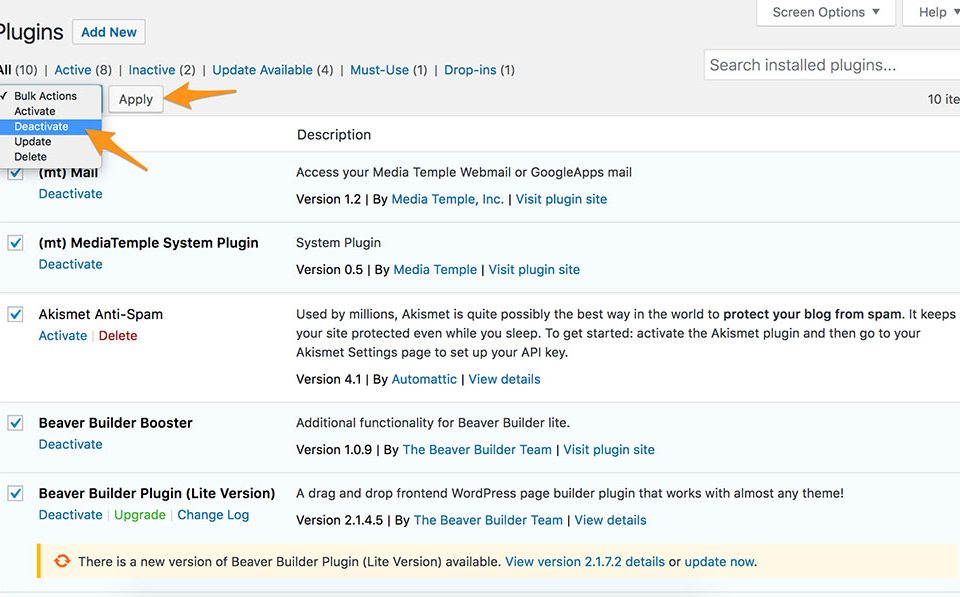
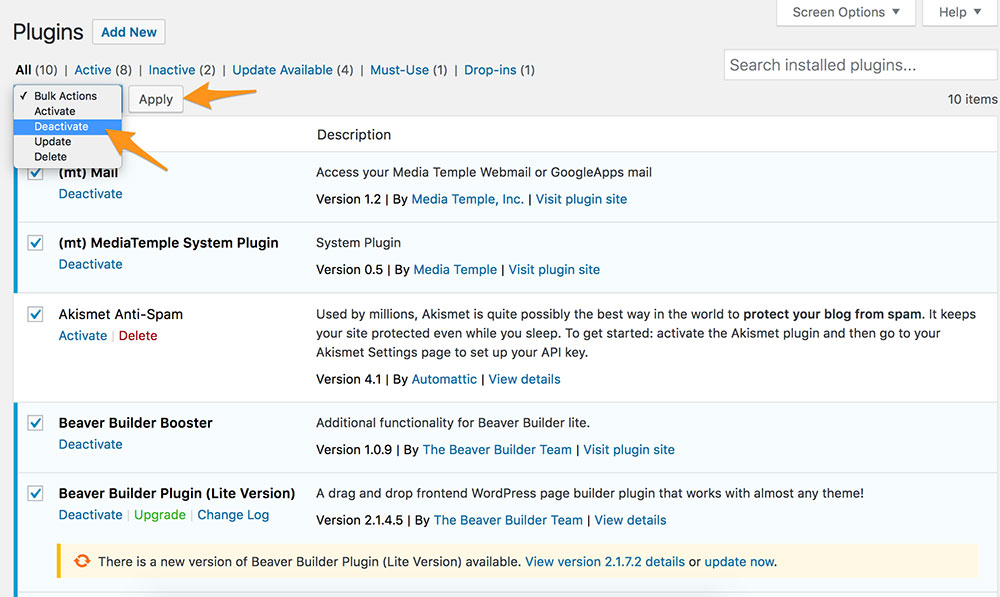
FTP method: Connect via FileZilla, navigate to /wp-content/, and rename the plugins folder to plugins_disabled. WordPress cannot find the folder, so all plugins deactivate instantly. The site loads without any plugin code.
Rename the folder back to plugins after the site is accessible. Then reactivate plugins one at a time, checking the site after each activation. The plugin that triggers the stream error on reactivation is the source.
WP-CLI method (faster if SSH is available):
wp plugin deactivate --all
This deactivates every active plugin in one command. Then wp plugin activate plugin-slug reactivates them individually during isolation testing.
Switching Themes Without Admin Access
If plugin deactivation does not resolve the stream error, the active theme file is the source. Switch to a default theme directly in the database.
Open phpMyAdmin, select your WordPress database, and open the wp_options table. Find 2 rows and update their option_value fields:
- template - change to
twentytwentyfour - stylesheet - change to
twentytwentyfour
Save both rows. WordPress now loads Twenty Twenty-Four, which ships with every WordPress installation. If the stream error clears, the original theme had a missing or corrupted file.
Re-upload the original theme from a clean download before reactivating it. If you are regularly getting locked out of WordPress through similar errors, that pattern suggests a broader maintenance gap, not just a one-off file issue.
| Recovery Method | Tool Required | Best For |
|---|---|---|
| Rename plugins folder | FTP client (FileZilla) | No SSH access |
| Deactivate all plugins | WP-CLI via SSH | Fast bulk deactivation |
| Switch theme via database | phpMyAdmin | Theme file stream errors |
| Enable WP_DEBUG log | FTP + text editor | Identifying exact error source |
How to Prevent the Failed to Open Stream Error in WordPress
Prevention comes down to 3 habits: use correct path references in custom code, run regular integrity checks, and test updates before pushing them live.
In 2023, the cybersecurity landscape saw a 24% increase in new vulnerabilities, with 5,948 recorded incidents (Managed-WP, 2024). Sites without maintenance routines absorb those vulnerabilities silently until something breaks.
Use WordPress Path Constants in Custom Code
Every hardcoded absolute path in a plugin or theme is a future stream error waiting to happen. Server moves, directory changes, and hosting migrations all break hardcoded paths.
Replace this pattern: require('/home/user/public_html/wp-content/myplugin/file.php');
With this pattern: require( WP_CONTENT_DIR . '/myplugin/file.php' );
WordPress constants resolve dynamically. They work correctly regardless of where the installation lives on the server.
Run Monthly Integrity Checks with WP-CLI
WP-CLI's checksum verification compares every installed file against WordPress.org's official MD5 checksums. Files that are missing, corrupted, or modified show up immediately in the output.
Two commands cover the full installation:
wp core verify-checksums- checks all WordPress core fileswp plugin verify-checksums --all- checks all plugins hosted on WordPress.org
Run both monthly, or immediately after any server migration, malware cleanup, or manual file restoration. A corrupted file that generates a stream error on the next page load is detectable before it causes a production outage.
Update One Plugin at a Time
Updating all plugins at once is common. It is also the reason why isolating the source of a post-update stream error takes hours instead of minutes.
Update one plugin, check the site, then move to the next. This takes 10 extra minutes and eliminates all diagnostic guesswork when something breaks.
For major WordPress version upgrades or PHP version changes, test on a staging environment first. Several managed WordPress hosts, including WP Engine and Kinsta, provide one-click staging environments specifically for this workflow.
Fix Permissions After Every Migration
Server migrations reset file ownership and permissions unpredictably. A file that had 644 permissions on the old server may arrive at 000 or 777 on the new one, depending on the transfer method.
Run a permission audit immediately after any migration using these 2 SSH commands:
find /path/to/wordpress -type d -exec chmod 755 {} \;
find /path/to/wordpress -type f -exec chmod 644 {} \;
Then set wp-config.php separately with chmod 600 wp-config.php. This 3-step sequence covers the full WordPress file structure and takes under a minute to run.
If your site has recently experienced related issues like WordPress failing to write files to disk, a permission audit on the uploads directory will likely surface the same root cause.
Back Up Before Every Update
A backup is not a prevention measure for stream errors. It is a recovery tool that cuts downtime from hours to minutes when prevention fails.
For active sites, daily backups are the standard recommendation. For lower-traffic sites, weekly backups provide adequate coverage against plugin-update failures and file corruption (Managed-WP, 2024).
Store backups off-server. A backup that lives on the same server as the site it protects is not a backup. Hosts like Kinsta, SiteGround, and WP Engine offer automated off-site backup storage as part of their managed hosting plans.
Common errors that follow similar patterns to the failed to open stream error, like the failed to load resource error or issues where WordPress cannot upload images, often share the same permission or file path root cause. A maintenance routine that covers permissions, integrity checks, and backups prevents most of them at once.
FAQ on How To Fix The Failed To Open Stream Error In WordPress
What does "failed to open stream: no such file or directory" mean in WordPress?
PHP tried to load a file using require() or include() but could not find it at the specified path. The file is either missing, moved, or the path in the code points to the wrong location on the server.
Why does this error cause a white screen in WordPress?
When require() fails, PHP throws a fatal error and halts execution immediately. The page cannot finish loading, so visitors see a blank screen or the "There has been a critical error on this website" message.
How do I find which file is causing the failed to open stream error?
The PHP error message itself tells you. Enable WP_DEBUG in wp-config.php and check wp-content/debug.log. The log shows the exact file path and line number triggering the stream failure.
Can a plugin update cause the failed to open stream error?
Yes. A failed or incomplete plugin update can leave missing plugin files on the server. PHP then calls a file that no longer exists, producing the stream error on every page load until the plugin is repaired or deactivated.
How do I fix file permission errors causing the stream failure?
Set WordPress files to 644 and directories to 755 via FTP or SSH. Run chmod 600 wp-config.php separately. Permissions set to 777 can also trigger stream failures on servers that block world-writable file execution.
How do I fix this error without access to wp-admin?
Rename the /wp-content/plugins/ folder via FTP to deactivate all plugins instantly. If a theme file is the source, update the template and stylesheet rows in the wp_options table using phpMyAdmin to switch to a default theme.
Does a PHP version upgrade cause failed to open stream errors in WordPress?
It can. PHP 8.0 removed functions like get_magic_quotes_gpc() used in older plugins. When those functions are called post-upgrade, PHP throws a fatal error that surfaces as a stream failure. Roll back PHP, update the plugin, then re-upgrade.
What is the difference between require() and include() in WordPress stream errors?
A require() failure produces a fatal error and stops execution completely. An include() failure produces a warning but lets the page continue loading. WordPress core files use require(), which is why stream errors from core typically cause a full site crash.
How do I prevent the failed to open stream error after a site migration?
Run a file permission audit immediately after migrating. Use WordPress path constants like WP_CONTENT_DIR instead of hardcoded server paths in custom code. Also run wp core verify-checksums to catch any corrupted or missing core files introduced during the transfer.
Can a corrupted wp-config.php cause the failed to open stream error?
Yes. Extra whitespace before the opening <?php tag or garbled characters in wp-config.php breaks the file loading sequence. Download the file, inspect it locally for corruption, and restore clean values without overwriting your database credentials.
Conclusion
This conclusion is for an article presenting every practical fix for the failed to open stream error in WordPress, from corrupted core files to broken require() calls and PHP version conflicts.
Most cases trace back to one of four root causes: a wrong file path, a missing plugin file, incorrect chmod values, or a PHP version mismatch after a server upgrade.
The recovery process is straightforward once you know where to look. Enable WP_DEBUG, read the debug.log, and the error message does most of the diagnostic work for you.
Long term, using WordPress path constants, running wp core verify-checksums monthly, and testing updates on a staging environment eliminates the majority of stream failures before they reach production.