

Blue Website Design Examples With Awesome Color Schemes
February 17, 2026
What “WordPress Mixed Content” Means and How to Fix It
February 19, 2026One misplaced character in a PHP file can take down an entire website. If you have ever seen a blank white screen or a parse error: syntax error, unexpected message, you know the frustration.
This error means the PHP interpreter hit something it did not expect. A missing semicolon, an unclosed bracket, a quote in the wrong place. The fix is usually simple once you know where to look.
This guide covers how to fix the parse error syntax error unexpected in PHP and WordPress. You will learn how to read the error message, identify the most common causes, debug your code with the right tools, and prevent these errors from happening again.
What Is a Parse Error Syntax Error Unexpected
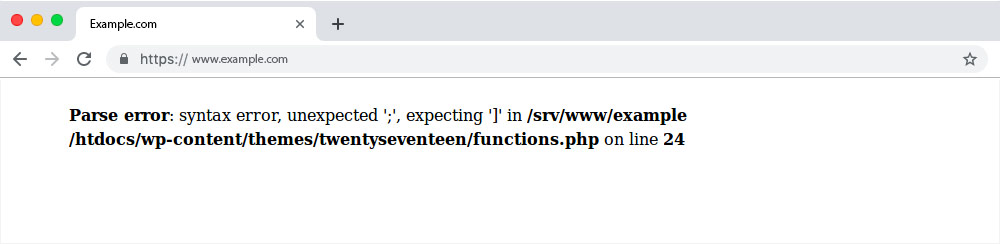
A parse error syntax error unexpected is a PHP interpreter message. It means the PHP engine hit a character or token it did not expect at that specific point in your code.
The full error usually reads something like: Parse error: syntax error, unexpected '}' or Parse error: syntax error, unexpected TSTRING. That word after "unexpected" tells you exactly what the PHP parser choked on.
This is not a warning. It is not a notice. A parse error stops your entire PHP script from running. Nothing executes until the syntax issue gets resolved.
Quick distinction here. Parse errors are different from runtime errors. A runtime error happens while your code is already executing (like dividing by zero or calling an undefined function). A PHP syntax error happens before execution even starts, because the interpreter cannot understand the structure of your code.
PHP powers roughly 75.8% of websites with a known server-side language, according to W3Techs data. WordPress alone accounts for over 43% of all websites on the internet. That is a massive number of sites where a single misplaced character in a PHP file can trigger this exact error and bring everything down.
ACM Queue research estimates that developers spend 35-50% of their time validating and debugging software. Syntax errors sit at the bottom of that debugging pile in terms of complexity, but they are also among the most common triggers, especially for anyone editing PHP files without a proper code editor.
How to Read the Error Message
The PHP error message gives you more information than most people realize. You just need to know what to look for.
Anatomy of a PHP Parse Error
A typical error message looks like this:
Parse error: syntax error, unexpected '}', expecting ';' in /var/www/html/index.php on line 42
Four pieces of data are packed into that single line.
- Error type: "Parse error: syntax error" tells you the interpreter failed to read your code structure
- Unexpected token: the character or token the parser did not expect at that position (in this case, a closing curly brace)
- Expected token: what the parser was actually looking for instead (here, a semicolon)
- File path and line number: where PHP thinks the problem is located
The "expecting" part does not always appear. Sometimes you just get the unexpected token and the line number.
Why the Line Number Is Often Wrong
This trips up almost everyone. The reported line number is frequently not where the actual mistake lives.
The PHP interpreter reads your code from top to bottom. When it hits something it cannot parse, it reports the line where it got confused. But the real problem, the missing semicolon or unclosed bracket, is usually on a line above the one in the error message.
If the error says line 42, start looking at line 41. Then 40. Then 39. The mistake often sits a few lines back from where PHP finally gave up trying to make sense of things.
"Unexpected end of file" is a special case. It means PHP reached the very end of your script while still expecting more code, usually a closing bracket or brace that was never provided. The real problem could be anywhere in the file.
Missing or Extra Semicolons
This is the single most common cause of a PHP parse error. Took me a while to stop making this mistake myself, and I still catch it occasionally when I am writing code late at night.
The Forgotten Semicolon
Every PHP statement needs to end with a semicolon. Forget one, and the interpreter tries to read the next line as a continuation of the current statement. That almost never works.
Broken:
$name = "John" echo $name;
Fixed:
$name = "John"; echo $name;
The error message for this typically says something like unexpected 'echo' (TECHO). PHP expected a semicolon after "John" but found the echo keyword instead.
The Semicolon That Should Not Be There
Less obvious but equally problematic. Adding a semicolon after a control structure opening breaks the logic.
Broken:
if ($loggedin); { echo "Welcome"; }
That semicolon after the if condition terminates the statement early. The curly brace block then becomes an anonymous block, and depending on the rest of your code, PHP may throw an unexpected token error further down the file.
How One Missing Semicolon Cascades
Here is why this error is so tricky. One missing semicolon on line 10 can cause the error to appear on line 25, line 50, or even at the very end of the file. PHP keeps trying to parse the broken statement, dragging in more and more of your code until it hits something completely incompatible.
The JetBrains State of PHP 2025 survey found that 59% of PHP developers still rely on vardump-style debugging approaches. Only 39% regularly use a debugger like Xdebug. That means most developers are hunting for these kinds of errors manually, which makes the cascading problem even more frustrating.
Unclosed Brackets, Parentheses, and Curly Braces
Right behind missing semicolons, mismatched delimiters are the second biggest source of PHP syntax errors. And they are harder to spot visually, especially in larger files.
Missing Closing Curly Braces
Every opening { needs a matching }. Miss one, and PHP reaches the end of the file still expecting more code.
The error message here is almost always "unexpected end of file" because the interpreter never found the closing brace it was looking for.
This gets particularly nasty with nested structures. A function inside a class, with an if/else inside the function, with a foreach inside the if block. Four levels of curly braces. Miss any one of them.
Extra Closing Braces
The opposite problem. An extra } where it does not belong will produce an "unexpected '}'" error. This sometimes happens after a quick copy-paste operation or when you accidentally delete a line that contained an opening brace.
Finding Mismatched Brackets Fast
Do not try to count brackets by hand in a 500-line file. Use your tools instead.
- VS Code bracket matching: place your cursor on any bracket, and the editor highlights its pair. The Rainbow Brackets extension color-codes nested pairs, making mismatches obvious at a glance.
- PHPStorm: shows bracket pair highlighting by default. Also underlines syntax errors in real time before you even save the file.
- Sublime Text: highlights matching brackets when you click on one, though the feature is subtler than VS Code's implementation.
The JetBrains State of PHP 2024 survey showed that 86% of PHP developers had adopted PHP 8.x. But adoption of proper IDE tooling varies. The PHPStorm community uses these bracket features automatically. Developers using basic text editors or the WordPress built-in editor do not have this safety net, and they are the ones who hit bracket errors most often.
Unexpected TSTRING, TVARIABLE, and Other Token Errors
The "T" prefix in PHP error messages stands for "token." These are the internal labels PHP uses for different code elements when it parses your script. Understanding what each one means saves a lot of guesswork.
| Token | What It Represents | Common Cause |
| T_STRING | A string identifier (text, function name, namespace). | Missing concatenation dot (.), missing semicolon on the previous line, or using a reserved keyword as a variable name. |
| T_VARIABLE | A PHP variable starting with $. |
Missing semicolon before the variable, or a forgotten comma in an array or function argument list. |
| T_CONSTANT_ENCAPSED_STRING | A quoted string literal ("foo" or 'bar'). |
Unmatched quotes, unescaped quotes inside a string, or a missing concatenation operator between a string and a variable. |
| T_ECHO, T_IF, T_FUNCTION | PHP keywords. | Usually triggered because the line above is missing a closing semicolon or has an unclosed curly bracket {. |
| T_PAAMAYIM_NEKUDOTAYIM | The scope resolution operator (::). |
Misusing static calls, such as $object::method() in an unsupported context or a typo in a class name. |
What TSTRING Really Means
An unexpected TSTRING error is one of the vaguest. It usually means PHP found a word or text where it expected something else entirely, like an operator, a semicolon, or a closing parenthesis.
Nine times out of ten, the cause is a missing concatenation dot between strings, a missing semicolon on the previous line, or an unclosed quote from a few lines up that turned the rest of your code into one long string.
What TVARIABLE Tells You
Getting unexpected TVARIABLE usually means the line above is incomplete. PHP was still processing the previous statement when it ran into a new variable definition. A missing semicolon or a missing operator (like a dot for concatenation) is the usual suspect.
Mixing Up Single Quotes and Double Quotes
This one catches people constantly, especially when writing HTML inside PHP echo statements.
Broken:
echo "<a href="https://example.com">Link</a>";
The double quotes around the URL close the string that started with echo ". Everything after that becomes gibberish to the parser.
Fixed (option 1, escaped quotes):
echo "<a href="https://example.com">Link</a>";
Fixed (option 2, alternating quotes):
echo '<a href="https://example.com">Link</a>';
If you build product websites or any PHP-driven pages, you will run into this quote nesting issue regularly. It is one of those things that becomes second nature after a while, but the first dozen times it catches you off guard.
Short Open Tags and PHP Version Mismatches
Sometimes the code is perfectly valid. It just does not work on your specific server or PHP version. This is one of the more confusing causes because the error appears even though the syntax looks correct.
Short Open Tags
PHP supports two ways to open a code block:
- <?php (standard, always works)
- <? (short open tag, depends on server configuration)
The short open tag <? requires the short_open_tag directive to be enabled in php.ini. If it is disabled on your server, any file using short tags will throw a parse error because PHP does not recognize <? as the start of a PHP block.
The fix is simple. Either enable short_open_tag = On in php.ini, or (better) replace all <? tags with <?php for maximum portability.
PHP Version Compatibility Issues
Code that runs fine on PHP 8.2 might throw a parse error on PHP 7.4. And the other way around, deprecated syntax from older versions can break on newer ones.
Features that cause parse errors on older PHP versions:
- Typed properties (PHP 7.4+): public string $name; triggers a parse error on PHP 7.3 and below
- Arrow functions (PHP 7.4+): $fn = fn($x) => $x * 2;
- Match expressions (PHP 8.0+): syntax does not exist in PHP 7.x
- Named arguments (PHP 8.0+): array_slice(array: $arr, length: 2)
- Property hooks (PHP 8.4+): brand new syntax that breaks on anything below 8.4
Zend's 2025 PHP Landscape Report found that 71.18% of teams now deploy PHP 8.x versions. But 23.59% are still on PHP 7.x, and 5.23% are running PHP 5.x or older. That means roughly one in four PHP environments could choke on modern syntax.
Stitcher.io version tracking data from June 2025 shows PHP 8.4 at just 13.6% adoption after half a year. PHP 8.3 leads at around 34%. Developers using newer language features like property hooks need to check what version their production server actually runs.
How to Check Your PHP Version
Two fast methods.
From the command line: run php -v and you get the full version number immediately.
From a PHP file: create a file containing <?php phpinfo(); ?> and open it in a browser. You get a full dump of your PHP configuration, including the version, loaded modules, and every php.ini setting. Delete this file when you are done. Leaving a phpinfo() file on a production server is a security risk.
If you manage sites built on a user friendly website platform like WordPress, keep in mind that your hosting provider controls the PHP version. Most hosts now let you switch PHP versions from cPanel or a custom dashboard, but some budget hosts still default to older versions.
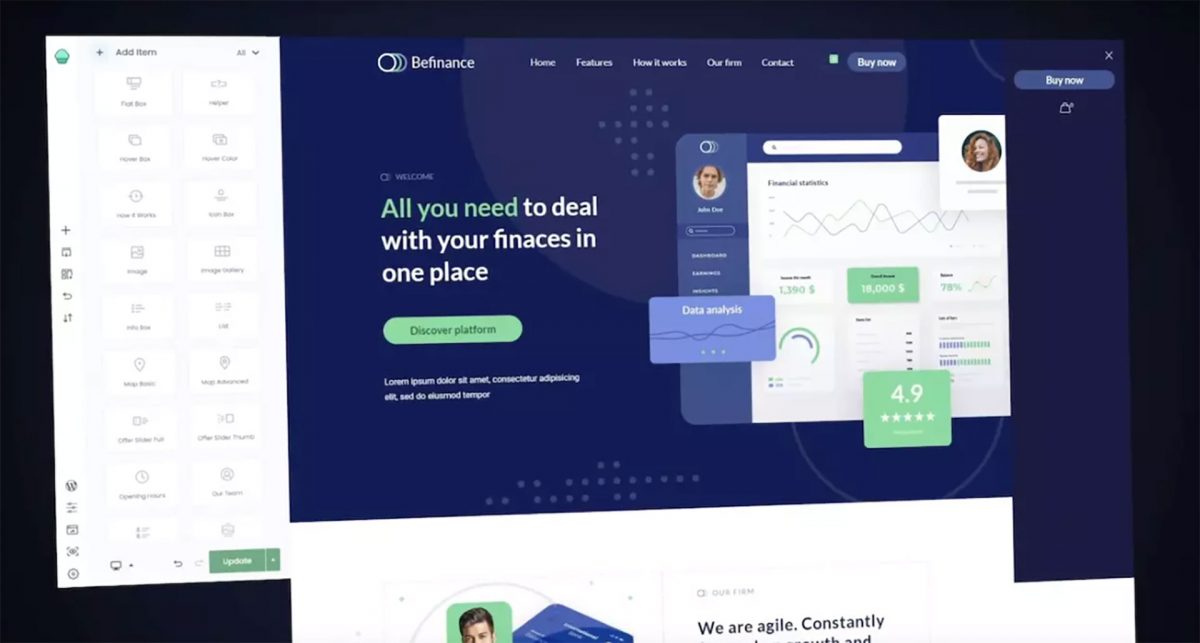
I'm interrupting the article to tell you about BeTheme, the definitive multipurpose theme. If trying to satisfy multiple clients has become more stressful than rewarding, BeTheme is the solution for that.

BeTheme’s selection of hundreds of customizable, responsive pre-built websites is the highlight and a proven stress reducer.
The customizability of the theme makes it a dream come true for its users. There are 4 types of Page Builders that you can use with it: WPBakery, BeBuilder, and Elementor among them.
And now with the Live Builder, it’s even more impressive.
Check out BeTheme and see why our users love it!
The rest of the article is down below.
Parse Errors After Editing WordPress Files
WordPress powers over 43% of all websites on the internet, according to W3Techs. That is hundreds of millions of sites running PHP under the hood. And a good chunk of those site owners will, at some point, paste a code snippet into functions.php and watch their entire site go white.
The WordPress parse error is the same PHP syntax error we have been discussing. But the context makes it worse, because a broken functions.php file can lock you completely out of your admin dashboard.
What Typically Goes Wrong
Pasting code from blog posts is the number one culprit. Many WordPress tutorials tell you to "add this to your functions.php" without mentioning the risks. One wrong character and the site is down.
Common mistakes when editing WordPress theme files:
- Pasting code with curly (smart) quotes instead of straight quotes, copied from a blog post or Word document
- Placing the snippet outside the opening
tag - Missing a semicolon or bracket in the pasted code
The WordPress built-in theme editor does not have syntax highlighting or error detection. It is basically a plain text box. There is no safety net.
Recovering When Your WordPress Site Shows a White Screen
A parse error in functions.php triggers the WordPress white screen of death. You cannot access wp-admin. The frontend shows nothing, or just the error message.
Fix it through FTP or File Manager:
- Connect to your server using FileZilla (or your host's cPanel File Manager)
- Go to
wp-content/themes/your-theme-name/ - Open functions.php and find the code you last added
- Remove it, or fix the syntax error the message pointed to
- Save and upload the file
If you are not sure what changed, download a fresh copy of your theme from the developer's site and replace the broken functions.php entirely.
Enabling WPDEBUG for Better Error Visibility
Sometimes the white screen gives you nothing. No error message at all. Enabling debug mode in wp-config.php changes that.
Open wp-config.php in your site's root directory and set define( 'WPDEBUG', true ); to replace the default false value.
Reload the site. Instead of a blank page, you should see the actual PHP error message with the file path and line number. That tells you exactly where to look.
Coralogix research shows developers spend roughly 75% of their time debugging, which amounts to about 1,500 hours per year. Having clear error messages instead of blank screens cuts that debugging time significantly.
How to Find the Exact Line Causing the Error
Knowing that a parse error exists is one thing. Finding the exact character that is breaking your script is another. The PHP error message gives you a starting point, but you need the right tools to close in on the actual problem.
Start at the Error Line, Then Look Up
The error says line 42. Start there. Does the code on that line look correct?
If yes, move up. Check lines 41, 40, 39. The real problem, the missing semicolon or unclosed bracket, almost always sits above the reported line. PHP kept reading past the mistake until it hit something truly incompatible.
Rule of thumb: the simpler the error (like a missing semicolon), the farther the reported line number can be from the actual mistake.
Using a Code Editor With Syntax Highlighting
If you are still editing PHP files in Notepad or the WordPress admin editor, stop. A proper code editor catches most syntax errors the moment you type them.
| Editor | Real-time Error Detection | Bracket Matching | Free |
| VS Code | Yes (Native AI + Language Servers) | Native Rainbow Brackets (Built-in) | Yes (Open Source) |
| PHPStorm | Deep Inspection (Built-in AI Agent) | Advanced (Scope-aware, native) | No ($ or Student/OS) |
| Sublime Text | Minimal (Requires LSP plugins) | Basic (Requires plugins for "Rainbow") | Freemium (Eval mode) |
The JetBrains State of PHP 2025 survey found that PHPStorm remains the top IDE for PHP. VS Code has a strong foothold within the WordPress community specifically. Either one will catch a missing semicolon or unclosed brace before you save the file.
Using PHP Linting to Catch Errors Before They Break Your Site
PHP has a built-in linter. Run php -l filename.php from the command line and it checks for syntax errors without executing the file.
Output when there is an error:
PHP Parse error: syntax error, unexpected TVARIABLE in filename.php on line 5
Output when the file is clean:
No syntax errors detected in filename.php
Since PHP 8.3, you can lint multiple files in one command using glob patterns. Older versions only checked one file at a time, so you needed a bash loop or a tool like PHP Parallel Lint for batch checking.
Linting catches syntax errors only. It will not find logic bugs, undefined variables, or runtime errors. For deeper analysis, tools like PHP CodeSniffer and PHPStan handle code quality checks beyond basic syntax.
Preventing Parse Errors in PHP
Fixing a parse error once is annoying. Fixing the same type of error repeatedly is a workflow problem. Most of these errors are completely preventable with the right setup.
Use a Real Code Editor
This is the single biggest thing you can do. A code editor with real-time PHP syntax checking catches errors as you type them, before they ever reach your server.
VS Code with the PHP Intelephense extension flags missing semicolons, unclosed brackets, and mismatched quotes instantly. PHPStorm does all of this out of the box.
The JetBrains 2025 survey shows 80% of PHP developers now regularly use AI assistants or AI-powered editors. These tools catch syntax issues even faster than traditional IDE inspections, often autocompleting brackets and quotes before you can forget them.
Test Changes Locally Before Deploying
Local development tools:
- XAMPP (Windows, Mac, Linux)
- MAMP (Mac, Windows)
- Laravel Valet (Mac)
- Local by Flywheel (WordPress-specific)
Edit your PHP files locally. Test them. Confirm they work. Then push to production. This one habit eliminates almost every "I broke my live site" scenario.
Use Version Control
Git lets you revert any file to its previous state in seconds. If a change breaks something, run git checkout -- filename.php and you are back to the last working version.
Without version control, reverting a broken change means either remembering what you changed (good luck) or restoring from a backup (if you have one).
Watch Out for Smart Quotes and Hidden Characters
This catches people who copy code from websites, blog posts, or PDF documents. Word processors and some CMS platforms automatically convert straight quotes (") into curly quotes. PHP does not understand curly quotes.
Same goes for invisible Unicode characters like zero-width spaces. They look like nothing in a browser, but they will break your PHP code with a confusing parse error.
Always paste code into a plain text editor first, then move it to your PHP file. Or paste directly into your code editor, which will usually flag these characters immediately. If you build professional websites, this is a habit worth having.
Parse Error Syntax Error Unexpected in Other Languages
PHP is not the only language where a missing bracket or semicolon stops everything. The same class of error shows up in JavaScript, Python, and pretty much any language with a parser.
JavaScript Unexpected Token Errors
JavaScript throws "SyntaxError: Unexpected token" for the same basic reasons as PHP. Missing brackets, extra commas, mismatched quotes.
The MDN Web Docs reference for this error lists dozens of variations, including Unexpected token ')', Unexpected identifier, and Unexpected end of input. The debugging approach is identical: check the reported line, look above it, and find the missing or extra character.
One key difference. Modern JavaScript runs in the browser, so you get syntax errors in the browser console (F12) rather than as a server error message. The feedback loop is faster.
Python SyntaxError
Python's equivalent is "SyntaxError: invalid syntax" or "SyntaxError: unexpected EOF while parsing."
The causes overlap with PHP (missing colons, mismatched parentheses, unclosed strings), but Python adds an extra layer: indentation. A wrong indent level triggers IndentationError, which is functionally a parse error. PHP and JavaScript do not care about whitespace. Python does.
The Debugging Approach Is the Same Across Languages
| Step | PHP | JavaScript | Python |
| Read the Error Message | File path + line number | Console + line/character | Traceback + line number |
| Check Reported Line | Yes, then look above | Yes, then look above | Yes, then look above |
| Use a Linter | php -l |
ESLint | Pylint, Flake8 |
| Use IDE Syntax Checking | PHPStorm, VS Code | VS Code, WebStorm | PyCharm, VS Code |
| The "Silent" Error | Semicolons & Brackets | undefined or null errors |
Indentation (Tab/Space) |
The pattern never changes. Read the error. Find the line. Look above it. Use a linter. Use a real code editor. These steps work regardless of the language you are writing in, whether that is for a technology website, a personal blog, or a complex web application.
FAQ on How to Fix the Parse Error Syntax Error Unexpected
What does "parse error: syntax error, unexpected" mean in PHP?
It means the PHP interpreter found a character or token it did not expect at that point in your code. The script cannot run until you fix the syntax issue. The error message includes the file path and line number to help you locate it.
Why does the error point to the wrong line number?
PHP reads code top to bottom. When it hits something unparseable, it reports where it got confused, not where the actual mistake is. The real problem, like a missing semicolon, usually sits a few lines above the reported number.
How do I fix a parse error if I am locked out of WordPress?
Connect to your server using an FTP client like FileZilla or your host's cPanel File Manager. Find the file mentioned in the error (usually functions.php), fix or remove the broken code, then re-upload the file.
What is the most common cause of this error?
A missing semicolon at the end of a PHP statement. This single character causes the interpreter to read the next line as a continuation, which almost always triggers an unexpected token error further down.
What does "unexpected TSTRING" mean?
TSTRING is PHP's internal label for a text identifier. This error usually means you have a missing concatenation dot, an unclosed quote, or a missing operator. Check the line above the reported error for the actual problem.
What does "unexpected end of file" mean?
PHP reached the end of your script while still expecting more code. This almost always means you have an unclosed curly brace or bracket somewhere in the file. Use your code editor's bracket matching feature to find it.
Can a PHP version mismatch cause a parse error?
Yes. Code written for PHP 8.x (like typed properties or match expressions) will throw a parse error on PHP 7.x. Run php -v on your server to check which version you are using before deploying newer syntax.
How do I check a PHP file for syntax errors without running it?
Use the built-in PHP linter from the command line: php -l filename.php. It checks for syntax errors without executing the file. Online tools like PHP Code Checker also work if you do not have terminal access.
Can a WordPress plugin cause a parse error?
Yes. A plugin update with broken PHP code or an incompatibility with your PHP version can trigger this error. Rename the plugin's folder via FTP to deactivate it, then check if the site loads again.
How do I prevent parse errors from happening again?
Use a code editor with real-time syntax checking, like VS Code or PHPStorm. Test changes locally with XAMPP or MAMP before pushing to production. Use Git so you can revert any breaking change in seconds.
Conclusion
Fixing the parse error syntax error unexpected in PHP comes down to reading the error message carefully and knowing where to look. The line number in the error is your starting point, not your answer. The real mistake almost always sits a few lines above.
Missing semicolons, unclosed curly braces, mismatched quotes, and PHP version incompatibilities cover the vast majority of cases. WordPress users face the added challenge of getting locked out when functions.php breaks, but FTP access and WPDEBUG solve that quickly.
The best fix is prevention. Use a code editor like VS Code or PHPStorm with real-time error detection. Run php -l` before deploying. Test locally with XAMPP or MAMP. Keep Git in your workflow so one bad edit never becomes a crisis.