
How to fix the “jQuery is not defined” error in WordPress
February 3, 2026
How to Fix the WordPress “Sorry, You Are Not Allowed to Access This Page” Error
February 9, 2026You share a link on Facebook and the preview looks broken. No image, wrong image, or some outdated thumbnail from three months ago. It's a common problem, and it kills engagement before anyone even reads your content.
If you're trying to figure out how to fix the Facebook link thumbnail not working error, the cause almost always comes back to Open Graph meta tags, Facebook's cache, or image requirements that aren't being met.
This guide walks through the actual fixes. You'll learn how to diagnose the problem using the Facebook Sharing Debugger, correct your og:image setup, clear cached previews, and handle platform-specific issues in WordPress, Shopify, and Facebook Ads Manager.
What Is the Facebook Link Thumbnail Not Working Error
You paste a link into a Facebook post, hit share, and... nothing. No image. Or worse, the wrong image shows up.
That's the Facebook link thumbnail not working error. It happens when Facebook can't pull the correct preview image from your page's metadata.
The problem shows up in a few different ways:
- Blank thumbnail: No image appears at all, just the page title and URL
- Wrong image: Facebook grabs a random image from the page (a sidebar ad, a logo, a footer icon) instead of your featured image
- Outdated thumbnail: You've updated the page, but the old image keeps showing because Facebook cached the previous version
This isn't limited to regular Facebook posts. The same issue affects Messenger link previews, Facebook Ads link previews inside Ads Manager, and shared links on Facebook business pages.
With 3.07 billion monthly active users on the platform (Demandsage, 2025), a broken or missing link preview image means your content looks unprofessional to a massive audience. Link posts already have the lowest engagement rate on Facebook at roughly 0.02% compared to 0.07% for image posts (ShortifyMe, 2024). A missing thumbnail makes that gap even wider.
The root of the problem is almost always tied to Open Graph meta tags. These are HTML snippets in the <head> section of your page that tell Facebook which image, title, and description to display. When those tags are missing, broken, or misconfigured, Facebook either guesses (badly) or shows nothing.
Why Facebook Shows the Wrong Thumbnail or No Thumbnail
Facebook doesn't just look at your page and pick the prettiest image. It reads specific metadata from your HTML.
When that metadata is wrong or missing, the link preview breaks. Here are the actual causes.
Missing or Incorrect Open Graph Tags
The og:image tag is what Facebook reads to find your thumbnail. If it's not there, Facebook falls back to scanning the page for any image it can find. Sometimes that's your header logo. Sometimes it's a 50x50 pixel tracking image. Either way, it's not what you wanted.
W3Techs data from March 2026 shows that 70.1% of all websites use the Open Graph protocol. That means roughly 30% of sites still don't have proper OG tags set up, which is a large chunk of the web sending broken previews to Facebook every day.
Facebook's Cache Holding Old Data
Facebook stores a snapshot of your page's metadata the first time someone shares the link. Update your featured image afterward? Doesn't matter. Facebook keeps showing the cached version until you manually force a refresh.
Took me a while to figure this one out the first time. I changed an og:image, shared the link again, and saw the same old thumbnail staring back at me. Turns out, Facebook's cache can hold onto old data for days or even weeks.
Image Size and Format Problems
Facebook won't display images smaller than 200 x 200 pixels. Period. Below that threshold, it treats the image as if it doesn't exist.
For the best display across devices (including high-resolution screens), Facebook recommends images sized at 1200 x 630 pixels with a 1.91:1 aspect ratio. Supported formats include JPEG, PNG, GIF, and WebP.
Server or CDN Blocking Facebook's Crawler
Your server's robots.txt file might be blocking Facebook's crawler from accessing the image. Same goes for CDN settings, firewall rules, or geographic restrictions. If the crawler can't reach the image URL, the thumbnail won't load.
Redirect chains cause issues too. If your og:image URL passes through two or three redirects before reaching the actual file, Facebook might give up before it gets there.
Relative URLs Instead of Absolute URLs
This one catches people off guard. Your og:image tag needs the full, absolute URL. Something like https://yoursite.com/images/thumbnail.jpg works. Just /images/thumbnail.jpg does not.
Facebook's crawler doesn't resolve relative paths. It needs the complete URL, including the protocol and domain.
How to Check Your Open Graph Tags
Before you fix anything, you need to see what Facebook actually sees. That means inspecting your page's HTML source.
Right-click anywhere on your page, select "View Page Source," and search for og:image. You should find something like this in the <head> section:
<meta property="og:image" content="https://yoursite.com/image.jpg" />
If you see nothing, that's your problem. If you see the tag but the URL points to a broken image, wrong image, or a relative path, now you know what to fix.
Common mistakes to watch for:
- Duplicate
og:imagetags (some themes and plugins both output their own, creating conflicts) - OG tags placed inside the
<body>instead of the<head>(Facebook won't read them there) - Typos in the property name (like
og:imagesinstead ofog:image)
Browser developer tools work well for this too. Open the Inspector, go to the Elements tab, and expand the <head> section to see all meta tags at once.
Open Graph Tag Requirements for Facebook Thumbnails
Here's a quick reference for what Facebook expects:
| Tag | Requirement |
|---|---|
og:image |
Absolute URL, minimum 200x200px, recommended 1200x630px |
og:title |
Clear, descriptive page title |
og:description |
Brief summary, 2-4 sentences max |
og:url |
Canonical URL of the page |
The image must be in JPEG, PNG, GIF, or WebP format. Keep the file size reasonable. If the image takes too long to load, Facebook's scraper may time out.
And this is the part people always miss: the URL in og:image has to be absolute. Not relative. Not protocol-relative. The full https:// path.
How to Use Facebook's Sharing Debugger to Fix Cached Thumbnails
The Facebook Sharing Debugger is the single most useful tool for this problem. It's free, it's built by Meta, and it shows you exactly what Facebook sees when it scrapes your page.
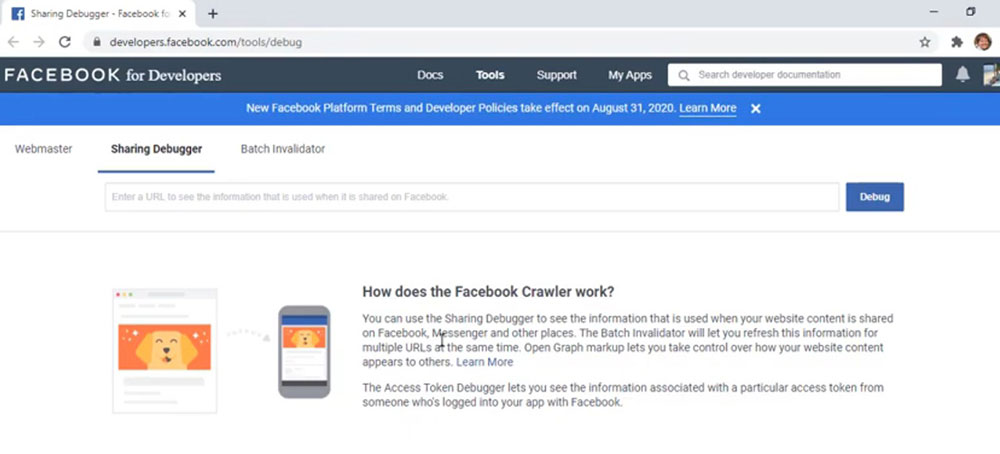
Go to developers.facebook.com/tools/debug/ and log in with any Facebook account.
Paste your URL into the input field and click "Debug."
The tool returns a full report: which og:image it found, the og:title, og:description, and any warnings about missing or misconfigured tags. It also shows a preview of how the link will appear when shared.
Key things to check in the results:
- og:image: Does it show the correct image URL?
- Warnings section: Look for messages about missing properties, image size issues, or blocked scraping
- Time Scraped: This tells you when Facebook last cached the page. If it's old, that explains the outdated thumbnail
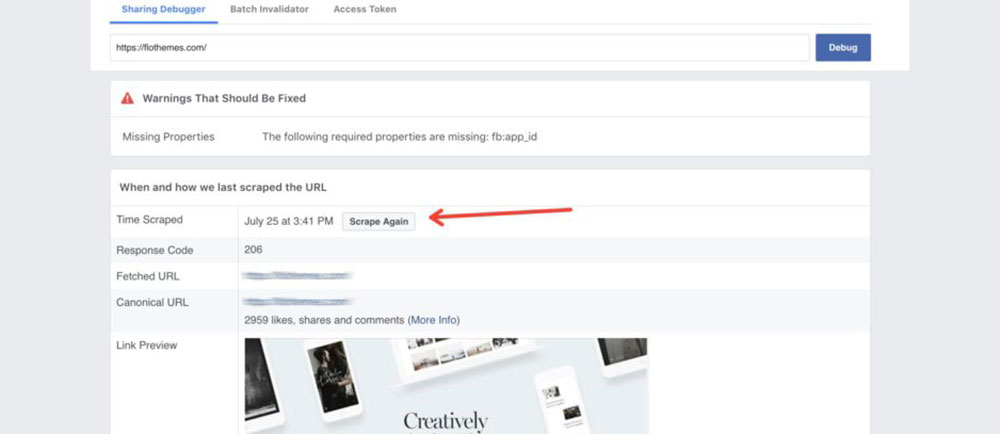
Once you've fixed your Open Graph tags on the actual page, come back to the Debugger and click "Scrape Again." This forces Facebook to re-fetch the metadata and clear its cache for that URL.
Sometimes one scrape isn't enough. If the updated thumbnail doesn't show immediately, click "Scrape Again" a second or third time. Facebook occasionally needs multiple requests to fully update its cache.
I usually scrape twice, wait about 30 seconds, then scrape once more. Works almost every time.
Fixing Facebook Thumbnails in WordPress
WordPress powers over 43% of all websites according to W3Techs, which means a huge number of people dealing with this thumbnail issue are running WordPress sites. The good news is that most WordPress SEO plugins handle Open Graph tags for you. The bad news is that plugin conflicts are one of the most common causes of the problem.
Using Yoast SEO, Rank Math, or All in One SEO
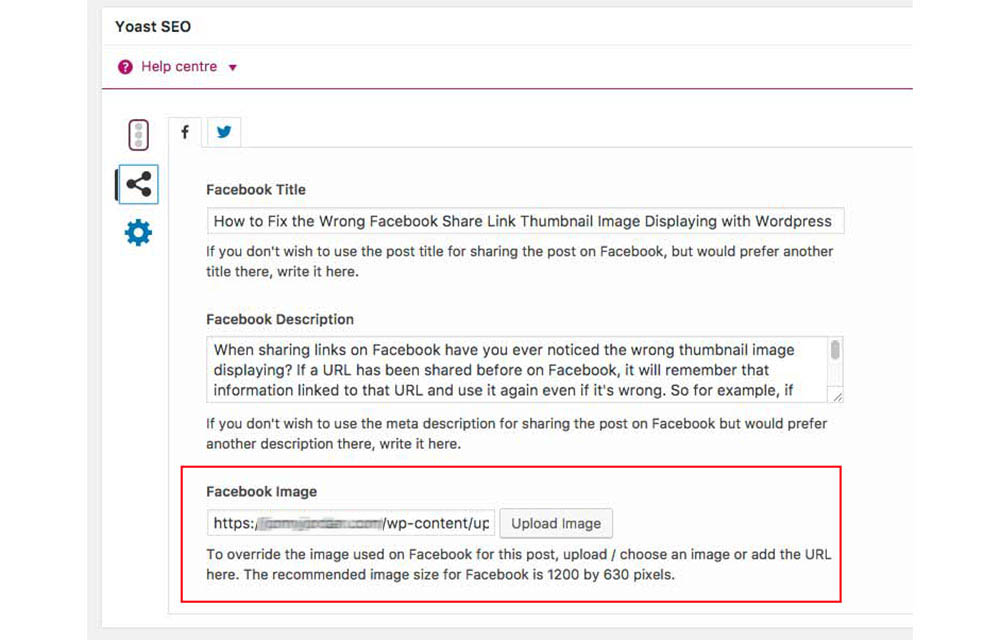
All three of these plugins generate og:image, og:title, and og:description tags automatically. Each one also lets you set a custom Facebook image for individual posts and pages.
In Yoast SEO: Open the post editor, scroll to the Yoast section, click the "Social" tab, then "Facebook." Upload or select the image you want Facebook to use.
In Rank Math: Same idea. Open the Rank Math meta box, click the "Social" tab, and set the Facebook image.
In All in One SEO: The "Social" settings tab in the post editor gives you the same option.
The problem hits when two plugins output competing og:image tags. If you have Yoast installed AND a social sharing plugin that also generates OG tags, Facebook might read the wrong one. Check your page source for duplicate tags and disable the OG output from whichever plugin you're not primarily using.
Theme-Level Issues
Some WordPress themes hardcode Open Graph tags directly into header.php. If your theme does this AND your SEO plugin generates its own OG tags, you end up with duplicates.
Look at your page source. If you see two og:image tags with different values, check whether one is coming from your theme and the other from a plugin. Remove the theme's version (or use a child theme so updates don't overwrite your changes).
Fixing Thumbnails on Other Platforms
Shopify: Go to the product or page settings and look for the social sharing image option. You can set a specific image that Facebook will use. Shopify generates OG tags automatically for products.
Squarespace: Each page has a social image setting under the page's SEO options. Upload your preferred image there. Squarespace handles the og:image tag generation.
Custom HTML sites: You'll need to add the OG tags manually in the <head> section of every page. There's no plugin to do it for you, but it's just a few lines of HTML. If you're building simple websites, this is a quick addition that makes a real difference in how your links look on social media.
Image-Specific Problems That Block Facebook Thumbnails
Sometimes your OG tags are perfectly configured. The og:image URL is there, it's absolute, it points to the right file. But the thumbnail still doesn't show.
The issue might be the image itself.
Image Too Small
Facebook ignores images below 200 x 200 pixels entirely. It won't try to resize them or use them as a fallback. They just get skipped.
For reliable display across all devices, stick with 1200 x 630 pixels. This size works for regular posts, Messenger previews, and Facebook Ads. If you're also designing pages with strong hero sections, those same images often double as great social sharing thumbnails.
Server Blocking Facebook's Crawler
Facebook's crawler needs direct access to your image URL. If your robots.txt blocks it, or your server has firewall rules that reject requests from Facebook's IP range, the image simply won't load.
Check your robots.txt file for lines like Disallow: /images/ or Disallow: /wp-content/uploads/. These can block the crawler from reaching your OG image even though the tag itself is correct.
HTTPS and Mixed Content Issues
If your site runs on HTTPS but your og:image URL points to an HTTP version of the image, Facebook may flag a mixed content warning and refuse to display it.
Make sure the protocol in your og:image tag matches your site. If your site is HTTPS, the image URL should be too.
Broken or Redirected Image URLs
An og:image URL that returns a 404 error is the same as having no tag at all. Facebook can't show an image that doesn't exist.
CDN transformations can cause this too. Some image CDNs generate different URLs for resized or optimized versions of an image. If the CDN URL in your og:image tag differs from the one the CDN actually serves, you'll get a mismatch. Good form design principles apply here too: always test your outputs before publishing.
| Image Problem | What Happens | Fix |
|---|---|---|
| Below 200x200px | Facebook ignores the image completely | Use 1200x630px |
| HTTP on HTTPS site | Mixed content warning, no display | Update to HTTPS URL |
| 404 broken URL | Treated as missing image | Fix the file path or re-upload |
| Robots.txt blocking | Crawler can't access image | Allow Facebook's user agent |
After fixing any of these, always re-scrape the URL in the Facebook Sharing Debugger to confirm the changes took effect.
How to Force Facebook to Update a Link Preview
You fixed your Open Graph tags. The og:image points to the right file, the URL is absolute, and the image meets Facebook's size requirements. But the old thumbnail still shows up when you share the link.
That's the cache talking. Here's how to force the update.
Re-Scraping via the Sharing Debugger
The fastest route. Go to developers.facebook.com/tools/debug/, paste the URL, click Debug, then hit "Scrape Again."
If the first scrape doesn't update the preview, click it again. Facebook sometimes needs two or three scrapes before the new metadata fully takes hold. Wait about 30 seconds between attempts.
One thing people overlook: Facebook caches HTTP and HTTPS versions of the same URL separately. Scrape both if your site has ever served content on either protocol.
Using the Facebook Graph API for Batch Refreshes
If you need to refresh dozens or hundreds of URLs at once, the Sharing Debugger's one-at-a-time approach won't cut it.
The Graph API method: Send a POST request to https://graph.facebook.com/ with the parameters id={your-url}&scrape=true&access_token={your-token}. This forces a re-scrape of that URL programmatically.
Meta also provides a Batch Invalidator at developers.facebook.com/tools/debug/sharing/batch/ that lets you paste multiple URLs and invalidate them all at once. Way faster than scraping one by one.
The Query String Workaround
When nothing else works, add a random query parameter to the end of your URL. Something like ?v=2 or ?fb=refresh.
Facebook treats this as a completely new URL and fetches fresh metadata from scratch. It's a hack, not a real fix. But it gets the job done when the cache refuses to cooperate.
Keep in mind that Facebook's CDN cache can take up to 24 hours to fully clear in some cases, even after scraping. If you're sharing a time-sensitive link, the query string trick is your safest bet.
Fixing Facebook Thumbnail Errors in Facebook Ads
Facebook Ads handle link previews a bit differently than organic posts. The ad system has its own caching layer, and the troubleshooting path has some extra steps.
The average click-through rate for Facebook Ads sits at 1.49% across industries, according to WebFX 2025 benchmarks. A broken or missing thumbnail drags that number down fast because users scroll right past ads that look unpolished or incomplete.
Refreshing Link Previews Inside Ads Manager
Step one: Fix your OG tags on the actual page and re-scrape in the Sharing Debugger (always do this first).
Step two: In Ads Manager, remove the URL from the ad creative, save, then paste it back in. This forces Ads Manager to re-fetch the link preview.
If the old thumbnail persists, create a new ad creative from scratch rather than editing the existing one. Ads Manager sometimes holds onto cached previews at the creative level even after the source page is updated.
Ad Creative Caching vs. Organic Post Caching
Organic posts pull directly from Facebook's URL cache. Ads have an additional caching layer tied to the specific creative object.
That's why you can see the correct thumbnail in the Sharing Debugger but still get the wrong one in your ad. The debugger reads the URL cache. The ad reads the creative cache. Two separate systems.
Jon Loomer has documented this issue extensively. Facebook removed the ability to manually edit link preview thumbnails on organic Page posts to fight misinformation and clickbait. For ads, though, you can still customize the creative (including the image) at the ad level. If your OG tags refuse to cooperate, uploading a custom image directly in Ads Manager bypasses the issue entirely.
Checking Placement Previews
Before publishing any ad, use the "Edit Placement" preview in Ads Manager to verify how the thumbnail appears across different placements (Feed, Stories, Right Column, Messenger).
Each placement crops and displays the image differently. An image that looks great in the Feed might get awkwardly cropped in the Right Column. Confirming across placements takes 30 seconds and saves you from wasting ad spend on a broken-looking creative. Honestly, this applies to the visual quality of any product landing page linked from an ad too.
Common Mistakes That Keep the Error Coming Back
Fixed the thumbnail once but it keeps breaking? You're not alone. These recurring patterns are behind most repeat offenders.
Forgetting to Update og:image After Content Changes
You swap out the featured image on a blog post but don't update (or check) the og:image tag. Most SEO plugins pull from the featured image automatically, but not all of them do. And some themes override the plugin's output.
Make it a habit: every time you change a page's main image, open the page source and confirm the og:image tag reflects the update.
Caching Plugins Serving Old HTML
This one is sneaky. You update your OG tags in WordPress, but your caching plugin (WP Super Cache, W3 Total Cache, LiteSpeed Cache, or Cloudflare) keeps serving the old HTML to Facebook's crawler.
The fix is simple but easy to forget: purge your site's cache after making any meta tag changes, before you re-scrape in the Facebook Sharing Debugger. Otherwise, the scraper reads the cached HTML, which still has the old og:image value.
Running multiple optimization plugins on the same WordPress site makes this worse. BlogVault's comparison of WP Super Cache and W3 Total Cache notes that these plugins integrate deeply into WordPress and create a "high potential for conflict" with other plugins and themes.
Duplicate og:image Tags from Multiple Sources
Two plugins outputting their own og:image tag. Or a theme hardcoding one in the header while your SEO plugin generates another. Facebook reads the first one it finds, which might not be the one you intended.
View your page source and search for og:image. If you see more than one, figure out which source is generating each tag and disable the duplicate at the source. When designing pages with a clean website layout, keeping your meta output clean matters just as much as the visual structure.
CDN Image Transform Mismatches
Some CDNs (Cloudflare, BunnyCDN, imgix) transform image URLs on the fly. Your og:image tag might point to yoursite.com/image.jpg, but the CDN actually serves the image from a completely different URL like cdn.yoursite.com/image.jpg?w=1200.
Facebook's scraper follows the URL in the tag literally. If that URL doesn't resolve to an accessible image, the thumbnail fails. Make sure the og:image URL matches what the CDN actually serves.
| Recurring Mistake | Why It Happens | Prevention |
|---|---|---|
| Stale og:image after update | SEO plugin doesn't auto-sync | Check page source after every change |
| Cache plugin serving old HTML | Cache not purged before re-scrape | Purge all caches first, then scrape |
| Duplicate og:image tags | Theme + plugin conflict | Audit source, disable the duplicate |
| CDN URL mismatch | Transform URL differs from og:image | Use the actual served URL in the tag |
Tools for Testing and Monitoring Open Graph Tags
The Facebook Sharing Debugger is your primary tool. But it only tells you how Facebook reads your page. A few other tools fill in the gaps.
OpenGraph.xyz
Best for: Quick visual previews across multiple platforms in one place.
Paste a URL and see how it will look when shared on Facebook, Twitter/X, LinkedIn, and Discord. All from a single tool. The aggregated view saves time when you need to confirm your OG tags work across social media channels, not just Facebook.
LinkedIn Post Inspector
LinkedIn reads the same og:image, og:title, and og:description tags as Facebook. If your thumbnail works on LinkedIn but breaks on Facebook (or the other way around), that narrows the problem down to platform-specific caching rather than a tag issue.
Access it at linkedin.com/post-inspector/ while logged in.
Screaming Frog for Site-Wide Audits
Testing individual pages works fine for one-off fixes. But if you manage a large site with hundreds of pages, you need a crawler.
Screaming Frog (and similar tools like Sitebulk) can crawl your entire domain and extract all og:image, og:title, and og:description values into a spreadsheet. You'll spot missing tags, broken image URLs, and duplicate meta properties across every page at once.
Plerdy's research recommends treating OG tag audits as part of your regular content QA process, especially after theme or plugin updates that can reset or override meta tag fields.
Browser Extensions for Quick Checks
Chrome extensions like Social Share Preview let you check OG tags on any page without leaving the browser. Right-click, inspect, done.
Handy for spot-checking pages before you share them. Not a replacement for a full audit, but good enough for daily use. If you're building professional websites, add this to your pre-launch routine.
| Tool | Best Use Case | Scope |
|---|---|---|
| Facebook Sharing Debugger | Primary debug + cache clearing | Single URL |
| OpenGraph.xyz | Multi-platform preview | Single URL |
| LinkedIn Post Inspector | Cross-platform comparison | Single URL |
| Screaming Frog | Full-site OG tag audit | Entire domain |
| Social Share Preview (Chrome) | Quick browser-based check | Single page |
FAQ on The Facebook Link Thumbnail Not Working Error
Why is my Facebook link preview not showing an image?
Your page is likely missing the og:image meta tag in the HTML head section. Without it, Facebook guesses which image to display. Sometimes it picks a random graphic. Sometimes it shows nothing at all.
What is the Facebook Sharing Debugger and how do I use it?
It's a free tool from Meta at developers.facebook.com/tools/debug/. Paste your URL, click Debug, and it shows exactly what Facebook reads from your page. Click "Scrape Again" to force a cache refresh.
What size should my Facebook thumbnail image be?
Facebook recommends 1200 x 630 pixels with a 1.91:1 aspect ratio. Minimum is 200 x 200 pixels. Anything below that minimum gets ignored completely. Stick with JPEG or PNG format for best results.
Why does Facebook show an old image after I updated my page?
Facebook caches link metadata. It keeps serving the old version until you manually clear it. Use the Sharing Debugger and click Scrape Again. Purge your site's caching plugin first if you run WordPress.
How do I fix the Facebook thumbnail in WordPress?
Use an SEO plugin like Yoast SEO or Rank Math. Open the post editor, go to the Social tab, and set a custom Facebook image. Check your page source for duplicate og:image tags from conflicting plugins.
What are Open Graph tags and why do they matter?
Open Graph meta tags are HTML snippets that tell Facebook which image, title, and description to display in link previews. Without them, Facebook scrapes your page and makes its own (often wrong) choices about what to show.
Can I fix Facebook thumbnails for multiple URLs at once?
Yes. Use Meta's Batch Invalidator at developers.facebook.com/tools/debug/sharing/batch/. Paste multiple URLs and invalidate them all at once. You can also use the Graph API to scrape URLs programmatically in bulk.
Why does the correct image show in the Debugger but not when I share?
Facebook Ads and organic posts use separate caching layers. The Debugger reads the URL cache, but your ad creative has its own cache. Remove and re-add the URL in Ads Manager, or create a new creative.
Does the og:image URL need to be absolute or relative?
Absolute. Always. Facebook's crawler does not resolve relative paths. Your og:image must include the full URL with protocol, like https://yoursite.com/image.jpg. A relative path like /image.jpg will fail.
How long does it take for Facebook to update a cached link preview?
After clicking Scrape Again, changes usually appear within seconds. In some cases, Facebook's CDN cache takes up to 24 hours to fully clear. Adding a query string like ?v=2 to the URL bypasses the cache instantly.
Conclusion
Fixing the Facebook link thumbnail not working error comes down to a short checklist. Verify your Open Graph tags are in the head section, confirm the og:image uses an absolute URL with the right dimensions, and clear both your site cache and Facebook's cache through the Sharing Debugger.
Most issues trace back to missing meta tags, duplicate properties from plugin conflicts, or stale cached data that Facebook refuses to let go of.
Build a testing habit. Run every URL through the Sharing Debugger before sharing it. Use tools like OpenGraph.xyz or LinkedIn Post Inspector to cross-check previews across platforms.
If you're on WordPress, pick one SEO plugin for OG tag output and disable all others. Purge your caching layer after every meta tag change. Check for CDN URL mismatches.
These aren't complicated fixes. They just require attention at the right moments. Get the tags right, clear the cache, and your link previews will display exactly as intended across Facebook posts, Messenger, and Ads Manager.